Beachcombers are collectors. They scour the beach in search of useful or valuable items. These can be all sorts of things: crates from a fishing boat, precious fossils, driftwood or messages in bottles. True beachcombers go to the beach specifically for this, preferably in stormy weather. That is when the chance is greatest that something special washes ashore. Along the high-water line there is the greatest chance of finding something. That is the line where the water reaches its highest level at high tide. When the tide goes out, many items are left behind precisely there. In the past, beachcombing was a way to earn some extra money. The washed-up items were used as building material or firewood, or were sold. Disasters at sea were thus a source of income for the beachcombers. Every seaside village had a few beachcombers. They tried to beat each other to it whenever there was something to be gained on the beach. The beachcombers often used horses to carry the items they found. These were usually Shires, an English horse breed.
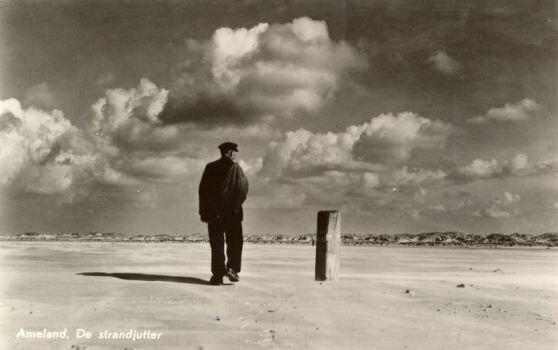
In the past, many more people in the Netherlands made their living from fishing than today. There were still real fishing villages where everyone lived from fishing. The men went out in their fishing boats and sometimes stayed away for weeks. Life at sea was much harder back then. Fishermen had far less equipment than today. Setting out nets and hauling in and cleaning the fish was done by hand. If something happened at sea, the fishermen could not easily call for help. Because of storms and bad weather, many more ships sank at sea than now. For the fishermen, that was part of their life. A saying the fishermen often used goes: the sea takes and the sea gives. Beachcombers too often speak of the things the sea has 'given'. In doing so, they give the sea a human quality. For people who always do their work on or near the sea, the sea may also be like a person. Pay attention to this the next time you hear beachcombers, fishermen or lifeboat crew talking.
Today, beachcombing is no longer a real profession but a hobby. The few beachcombers still left in the Netherlands do not just roam the beach looking for useful items. You can also take a look at today's beachcombers. Adults and children can take a ride along the beach, join a beachcombing treasure hunt or visit one of the beachcombing museums. On Ameland there is the agricultural and beachcombing museum Swartwoude in Buren.